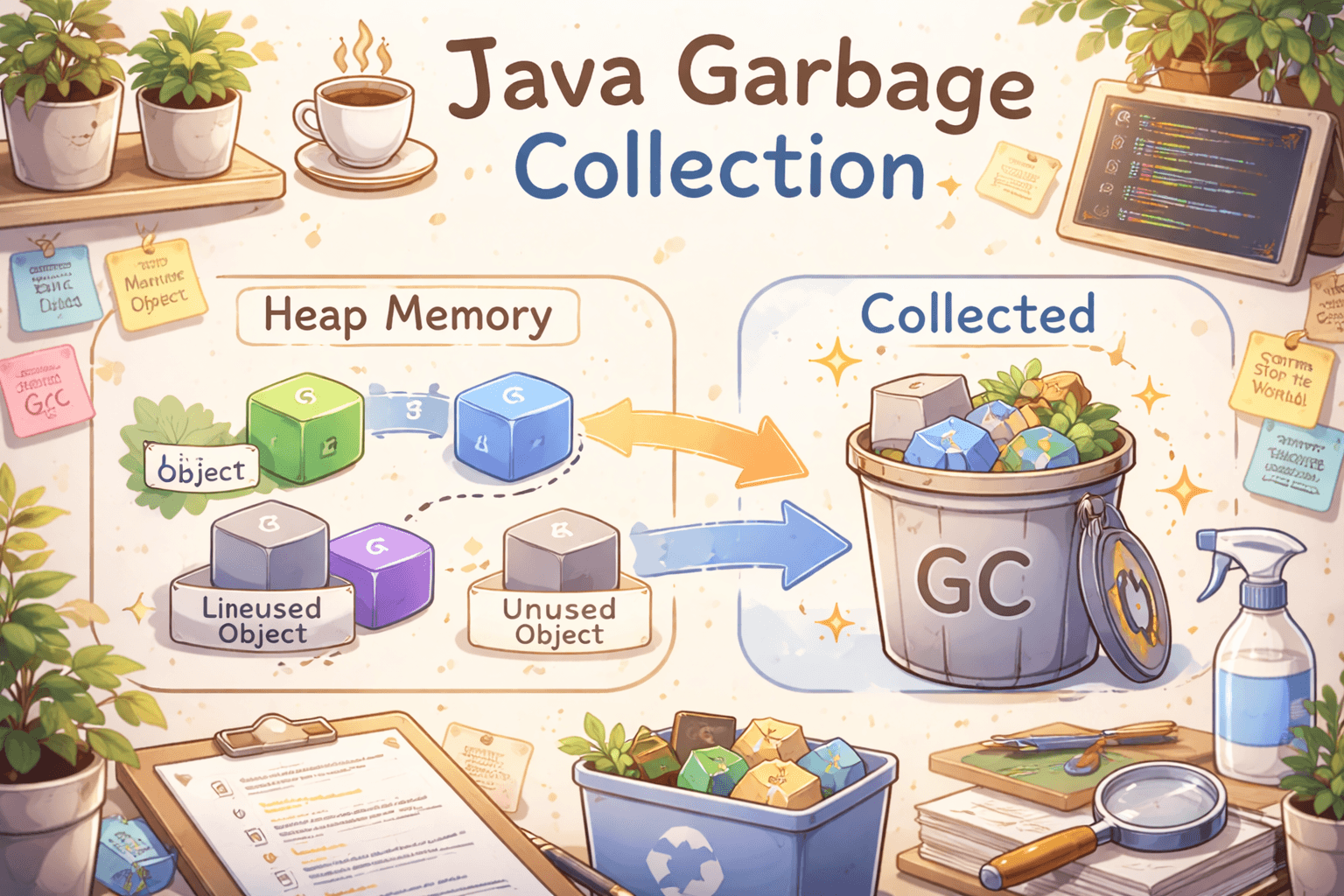
Understanding Garbage Collection in Java
Understanding Garbage Collection in Java
Introduction
Garbage Collection (GC) is one of Java's most important features, automatically managing memory by reclaiming memory occupied by objects that are no longer in use. This article explores how Java's garbage collection works, its algorithms, and best practices.
What is Garbage Collection?
Garbage Collection is the process of automatically freeing memory by removing objects that are no longer referenced by the application. In Java, developers don't need to manually deallocate memory like in languages such as C or C++.
Key Benefits
How Garbage Collection Works
Object Lifecycle
1. Object Creation: Objects are created in the heap memory
2. Object Usage: Objects are referenced and used by the application
3. Object Unreachability: When no references point to an object, it becomes eligible for GC
4. Garbage Collection: GC identifies and removes unreachable objects
Reachability
An object is considered reachable if:
An object becomes unreachable (eligible for GC) when:
Garbage Collection Algorithms
1. Serial GC
2. Parallel GC
3. G1 GC (Garbage First)
4. ZGC (Z Garbage Collector)
Best Practices
1. Monitor GC Performance: Use tools like JVisualVM or GC logs
2. Choose the Right GC: Select based on your application's requirements
3. Tune Heap Size: Set appropriate -Xms and -Xmx values
4. Avoid Memory Leaks: Remove references when objects are no longer needed
5. Use Object Pooling: For frequently created/destroyed objects
Conclusion
Understanding garbage collection is crucial for Java developers. By choosing the right GC algorithm and following best practices, you can optimize your application's performance and memory usage.